
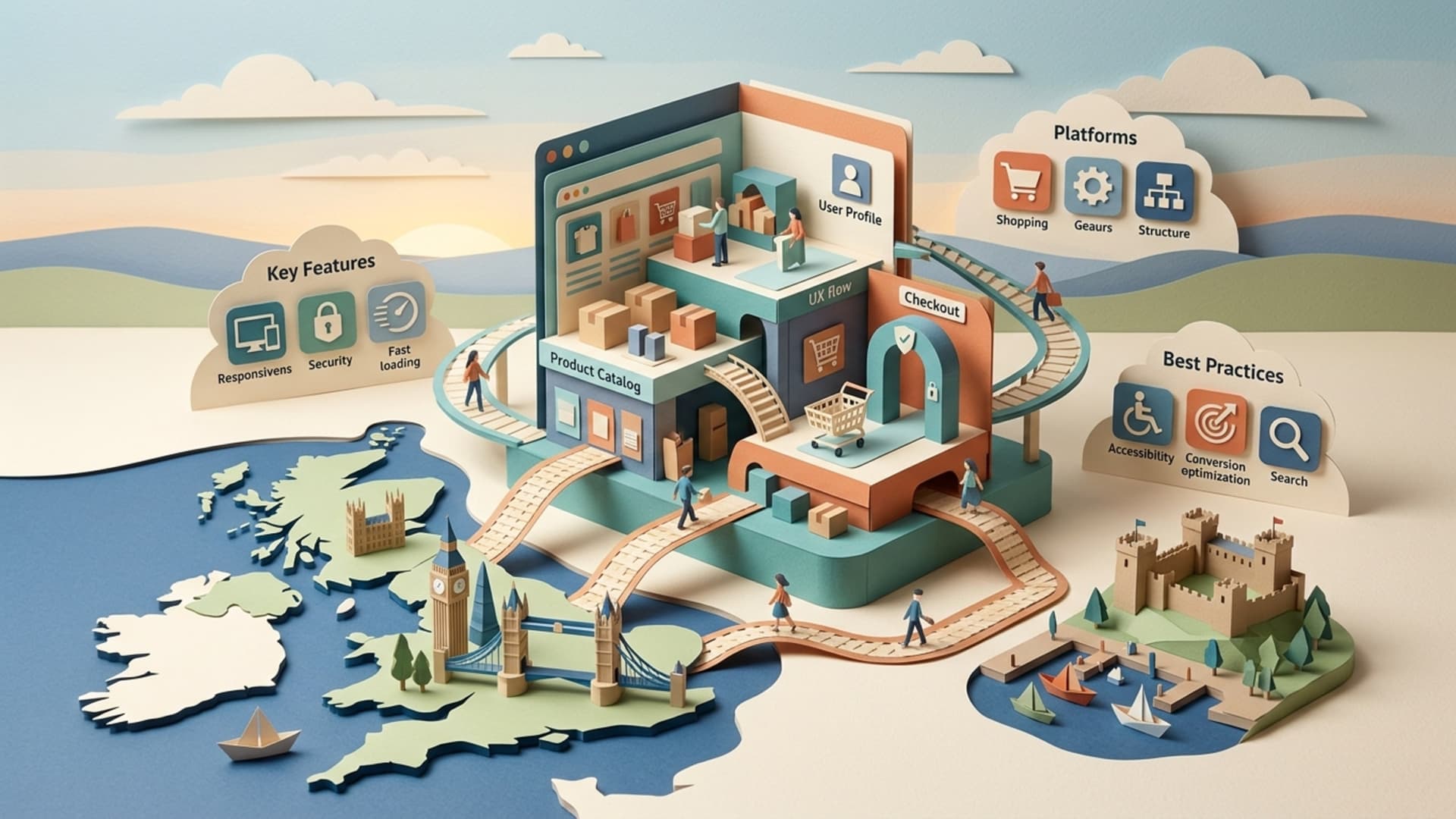
Ecommerce Web Design Services UK 2026: Key Features, Platforms, and Best Practices
For UK SMEs and growth-focused brands launching or redesigning an online store, ecommerce web design services in 2026 must go beyond aesthetics to deliver a seamless, conversion-optimised experience. With online retail now accounting for 27–28% of total UK sales (Source: The Commerce Team), the stakes are higher than ever. This article builds on the fundamentals covered in our comprehensive guide to web design services and dives deeper into the specific features, platforms, and best practices that drive ecommerce success.
Key Features of Ecommerce Web Design for UK Businesses
Every ecommerce website needs a set of core features to compete effectively in 2026:
- Optimised Product Pages: High-quality images, clear descriptions, customer reviews, and dynamic pricing. Use AI to recommend complementary products in real-time — 40% of enterprise apps now embed task-specific AI agents (TechRadar).
- Streamlined Cart and Checkout: Reduce friction with guest checkout, address autocomplete (Royal Mail PAF), and multiple payment options including Apple Pay, Google Pay, and Klarna. Cart abandonment costs UK retailers over £18 billion annually — a smooth checkout is non-negotiable.
- Secure Payment Gateway Integration: Trust is vital. Integrate UK-friendly gateways like Stripe, Worldpay, or Sage Pay with SSL encryption and SCA compliance.
- Mobile-First Responsive Design: With over 50% of ecommerce traffic coming from mobile devices in the UK, your site must prioritise touch-friendly navigation, fast load times, and thumb-friendly CTAs. Google’s mobile-first indexing reinforces this.
- Unified Commerce Capabilities: Sync inventory, pricing, and orders across online and physical stores. Over 80% of shoppers blend online and in-store journeys (The Commerce Team) — a unified platform ensures consistent experiences.
- SEO-Ready Architecture: Clean URL structures, schema markup (Product, Offer, Review), and fast Core Web Vitals (LCP under 2.5s, FID under 100ms) are essential for ranking in Google Shopping and organic results.
Choosing the Right Ecommerce Platform
Your choice of platform shapes your store’s scalability, cost, and management complexity. Here’s how the top three compare for UK businesses in 2026:
| Platform | Best For | Key Considerations |
|---|---|---|
| Shopify | SMEs, fast go-to-market, subscription-based revenue | From £25/month, easy setup, hundreds of apps. Transaction fees (1.4% + 20p for UK cards) unless using Shopify Payments. Built-in SEO and mobile optimisation. |
| WooCommerce | Businesses needing full control, existing WordPress sites | Free plugin, but requires hosting (£10–£30/month) and developer costs. Highly customisable with extensions. Ideal for content-rich stores with unique needs. |
| Magento (Adobe Commerce) | Mid-market to enterprise, complex catalogues, B2B | Scalable but resource-heavy — hosting from £100+/month and developer costs are significant. Offers advanced B2B features, multi-store management, and superior performance. |
For most UK SMEs, Shopify or WooCommerce strike the right balance between cost and capability. However, if you anticipate rapid growth or need complex B2B functionality, Magento (now Adobe Commerce) remains a powerful option. An experienced ecommerce web design partner like Prebo Digital can help you evaluate these based on your business model.
Mobile-First Design and User Experience
In 2026, mobile-first is not a trend — it’s the starting point. UK mobile traffic dominates, and Google predominantly uses the mobile version of your site for indexing. Key practices include:
- Touch-Friendly Elements: Buttons at least 48x48px, adequate spacing, and swipeable galleries.
- Fast Loading: Compress images (WebP format), minimise JavaScript, and leverage browser caching. Aim for under 2 seconds on 4G.
- Simplified Navigation: Use hamburger menus sparingly; prefer sticky navigation with search and cart icons. Display category links in a clear hierarchy.
- Thumb-Reachable Actions: Place primary CTAs (Add to Cart, Checkout) within easy thumb reach — the bottom half of the screen.
SEO for Ecommerce Product Pages
Ecommerce SEO in 2026 focuses on product page optimisation to capture high-intent traffic. Key tactics:
- Unique Product Descriptions: Avoid manufacturer duplicates. Write original copy that includes primary keywords and long-tail variations.
- Structured Data: Implement Product, Offer, and Review schema to enable rich snippets (price, availability, ratings) in search results.
- User-Generated Content: Encourage reviews and Q&A — they add fresh content and improve trust signals.
- Internal Linking: Link products to related items and blog content (e.g., “5 Ways to Style This Dress”) to distribute link equity and improve navigation.
- Core Web Vitals: Monitor LCP, FID, and CLS via Google Search Console. Poor scores directly impact rankings. A professional ecommerce web design service will bake these optimisations into the build.
Conversion Rate Optimisation Techniques for Online Stores
Driving traffic is only half the battle — your site must convert. UK ecommerce conversion rates average 2–3%, but top-performing stores achieve 5% or higher through:
- Clear Value Propositions: Display free shipping thresholds (e.g., “Free delivery on orders over £50”) prominently on product pages and in the cart.
- Trust Signals: Include security badges, customer logos, and easy-to-find returns policies. UK consumers are cautious — 86% check return policies before purchasing.
- Urgency and Scarcity: Use countdown timers for limited-time offers and low-stock alerts (e.g., “Only 3 left in stock”).
- A/B Testing: Test headline copy, button colours, and product image placement. AI tools can automate multivariate testing across segments.
- Cart Abandonment Recovery: Implement email and SMS sequences triggered by abandoned carts. Offer a discount or free shipping incentive — but test to avoid conditioning.
The Role of AI in Ecommerce Web Design
AI is reshaping ecommerce design. By 2026, 76% of designers view AI as a threat (20i), but savvy businesses harness it to:
- Generate personalised product recommendations based on browsing and purchase history.
- Automate dynamic pricing and promotions.
- Create chatbots for instant customer support (reducing response time).
- Analyse heatmaps and session recordings to identify UX friction points.
That said, human creativity remains irreplaceable. AI should augment—not replace—strategic design decisions. A balanced approach ensures your store feels unique and trustworthy.
Sustainable Web Design for Ecommerce
UK consumers increasingly care about environmental impact. Lightweight, energy-efficient websites reduce carbon footprint and load faster. Practices include:
- Using minimal, clean code.
- Optimising images and videos.
- Reducing third-party scripts (trackers, widgets).
- Choosing green hosting providers (e.g., Kualo, GreenGeeks).
These practices also improve SEO and user experience — a triple win.
Why Partner with a Specialist Ecommerce Web Design Agency?
Designing a high-performing ecommerce site requires deep expertise in UX, platform capabilities, SEO, and CRO. A specialist agency like Prebo Digital UK understands the unique demands of UK retailers, from best-buy box placements to integrating payment gateways that shoppers trust. We combine data-led strategy with creative execution to deliver measurable ROI. Our team is Google Premier Partner and Meta Business Partner accredited, with hands-on experience across Shopify, WooCommerce, and Magento.
Ready to build an ecommerce site that drives real growth? Contact Prebo Digital UK at info@prebodigital.co.uk or call +44 7450 552860 to discuss your project. We serve businesses across Birmingham, Coventry, Leicester, London, and the wider UK.
Frequently Asked Questions
What is the cost of ecommerce web design services in the UK in 2026?
Costs vary widely based on complexity. A basic Shopify store from an agency typically starts at £5,000–£10,000, while a custom Magento site can exceed £30,000. Ongoing monthly fees (hosting, maintenance, SEO) range from £500–£2,000.
How long does it take to design and launch an ecommerce website?
A standard project takes 8–16 weeks, depending on product catalogue size, integrations, and custom features. A simpler Shopify store might go live in 4–6 weeks.
Should I choose Shopify or WooCommerce for my UK ecommerce store?
Shopify is ideal for ease of use and built-in features; WooCommerce offers more flexibility and lower transaction fees but requires more management. Consider your technical resources and long-term scalability.